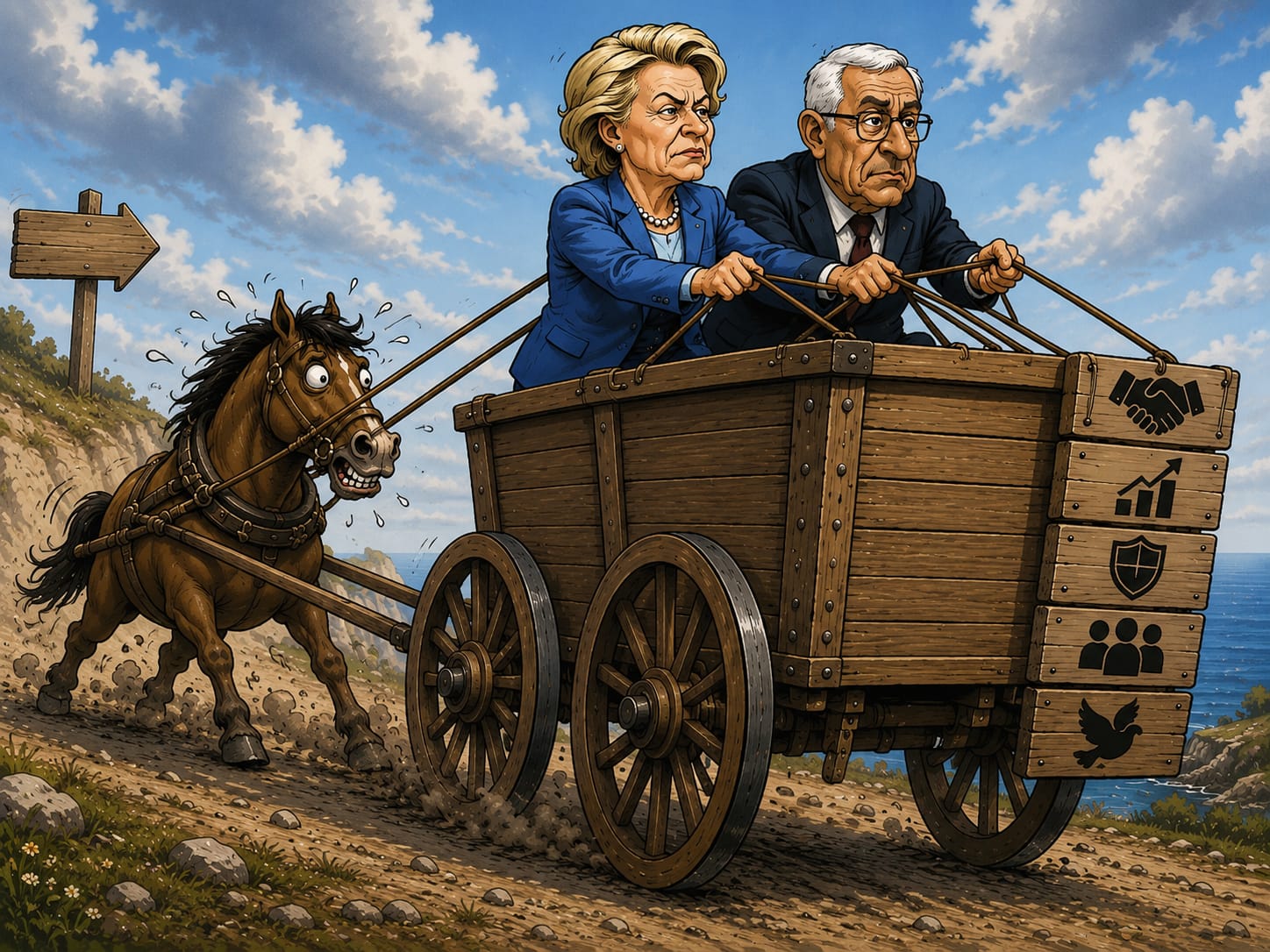
By Yusuf Kanlı
Europe’s strategic rapprochement with Türkiye should become the catalyst for solving Cyprus rather than remaining hostage to it. A continent searching for security must abandon outdated conditionality and recognize that a confident, respected Türkiye is far more likely to invest political capital in a lasting settlement on the island.
Europe finds itself living through one of the most profound strategic transformations since the end of the Cold War. Russia’s invasion of Ukraine has permanently altered the continent’s security calculations. NATO has begun redefining itself for a new era of great-power competition. The United States is gradually redirecting strategic attention toward the Indo-Pacific and long-term competition with China. The Middle East has become increasingly volatile, while the Black Sea, the Eastern Mediterranean and critical transport corridors have acquired unprecedented geopolitical significance. Across Europe, governments are rediscovering concepts that many believed belonged to history: deterrence, industrial capacity, logistics, strategic resilience and geography.
Few countries have benefited more from this reassessment than Türkiye.
Only a few years ago Ankara was frequently portrayed in European political discourse as a troublesome ally, a difficult accession candidate and an increasingly unpredictable regional actor. Today, the same European capitals openly acknowledge that any credible European security architecture will require close cooperation with NATO’s second-largest military, one of Europe’s fastest-growing defense industries and a country that occupies the strategic crossroads linking the Black Sea, the Caucasus, the Balkans, the Eastern Mediterranean and the Middle East. The Ankara NATO Summit merely confirmed what European policymakers had already begun to recognize: Türkiye is no longer a peripheral partner. It has once again become central to Europe’s strategic future.
Yet despite this dramatic transformation, one element of European policy has remained almost completely unchanged.
Whenever Brussels discusses modernization of the Customs Union, visa liberalization, Turkish participation in European defense initiatives or broader political normalization, the conversation inevitably returns to the same familiar formula. Progress, Europe insists, depends on movement on Cyprus.
That approach may appear logical inside the institutional structures of the European Union. It certainly reassures Greece and the Republic of Cyprus that their concerns remain central to European policy. Yet after more than two decades of applying precisely the same diplomatic formula, it is becoming increasingly difficult to argue that it has produced the desired results.
Europe continues to place the cart before the horse.
The strategic map has changed
The Ankara Summit illustrated that NATO itself has entered a fundamentally different phase of its evolution. The Alliance reaffirmed Article 5, embraced higher defense spending, accelerated military industrial cooperation and shifted its attention toward long-term resilience rather than simply crisis management. While Russia remains NATO’s principal military challenge, the Alliance has adopted a broader understanding of security that extends from the High North to the Middle East and from the Baltic to the Eastern Mediterranean.
Within this emerging strategic geography, individual allies are assuming renewed regional roles. Poland has become NATO’s principal land front confronting Russian expansionism. Norway anchors the Alliance’s northern flank as Arctic competition intensifies. Türkiye has resumed the strategic position it occupied throughout much of the Cold War as the indispensable southern flank power, simultaneously influencing developments in the Black Sea, the Eastern Mediterranean, the Caucasus and the Middle East. Geography has once again become one of the Alliance’s most valuable strategic assets, and no European country possesses a geographical position comparable to Türkiye’s.
This transformation extends well beyond military deployments. Europe’s future security depends upon defense production, energy diversification, resilient supply chains, transportation corridors, maritime security and regional diplomacy. Türkiye contributes to every one of these priorities. Its defense industry has become one of NATO’s fastest-growing manufacturing centers. Its logistics infrastructure connects Europe with Asia. Its diplomatic channels extend simultaneously to Kyiv, Moscow, the South Caucasus and much of the Middle East. As Washington gradually encourages European allies to assume greater responsibility for their own security while concentrating more resources on China, Ankara’s strategic value will only continue to grow.
European leaders understand these realities perfectly well.
Their renewed engagement with President Recep Tayyip Erdoğan, discussions on integrating Türkiye into Europe’s emerging defense industrial framework, growing interest in Customs Union modernization and revived high-level political dialogue all reflect an acceptance that the relationship can no longer remain frozen in the disputes of the previous decade.
The Cyprus paradox
Ironically, it is precisely at this moment of renewed strategic convergence that Europe continues relying upon one of its oldest diplomatic assumptions.
The Erdoğan-Costa-von der Leyen dinner in Ankara perfectly illustrated this contradiction. The meeting reflected Europe’s recognition that cooperation with Türkiye has become indispensable in fields ranging from defense and migration to energy and regional security. Yet European leaders also reiterated that broader progress in EU-Türkiye relations remains closely linked to developments on the Cyprus question.
The logic appears straightforward.
Resolve Cyprus, and broader normalization with Europe becomes possible.
The problem is that history has demonstrated precisely the opposite.
For more than twenty years the European Union has attempted to use the prospect of deeper integration as leverage for encouraging flexibility on Cyprus. During exactly the same period, Cyprus has remained divided, Türkiye’s accession process has effectively frozen, the Customs Union has remained outdated, visa liberalization has stalled and mutual political confidence has steadily deteriorated.
If anything, the existing framework has encouraged both sides to become more entrenched.
Ankara increasingly came to view Brussels as an institution that had sacrificed impartiality after admitting the Republic of Cyprus into the Union despite the rejection of the Annan Plan in 2004. From the Turkish perspective, Europe rewarded rejection while leaving Turkish Cypriots, who had overwhelmingly endorsed reunification, politically and economically isolated.
The Greek Cypriot administration, meanwhile, acquired perhaps the strongest negotiating position in the island’s modern history. Membership of the European Union provided not only international legitimacy but also an effective institutional veto capable of slowing or blocking key aspects of EU-Türkiye relations. Under such circumstances, political incentives for difficult compromise inevitably weakened.
Neither side benefited.
The diplomatic architecture itself became part of the problem.
Reversing the sequence
Europe’s strategic reassessment offers an opportunity to replace a policy that has failed with one that might finally succeed.
Rather than insisting that progress on Cyprus must precede every significant improvement in relations with Türkiye, Brussels should reverse the sequence entirely.
The European Union should modernize the Customs Union because doing so benefits both European and Turkish economies. It should advance visa liberalization because stronger societal interaction builds political confidence. It should integrate Türkiye into Europe’s evolving defense industrial ecosystem because European security increasingly requires Turkish industrial capacity. It should restore regular high-level political dialogue because successful diplomacy depends upon sustained communication rather than episodic crisis management.
None of these measures should be interpreted as concessions to Ankara.
They are investments in Europe’s own strategic future.
More importantly, they would transform the political atmosphere surrounding Cyprus itself.
Diplomatic history consistently demonstrates that durable settlements emerge from confidence rather than coercion. Governments that trust one another find compromise politically easier to explain to domestic audiences. Governments trapped in relationships defined by suspicion and conditionality generally discover that even modest compromises become politically impossible.
Türkiye is no exception.
Why a stronger partnership serves Cyprus
Some European policymakers fear that separating broader EU-Türkiye relations from Cyprus would somehow reduce incentives for Ankara to contribute constructively to the peace process.
The opposite is far more likely.
Today’s Türkiye approaches Europe from a position of significantly greater strategic confidence than at any point during the previous decade. NATO increasingly depends upon Turkish military capabilities. Washington has reopened discussions on sanctions relief, defense industrial cooperation and even the possibility of renewed dialogue concerning the F-35 program. European governments increasingly acknowledge that excluding Türkiye from continental defense planning has become strategically unsustainable.
A country that feels respected, strategically valued and politically included possesses far greater incentive to invest diplomatic capital in resolving long-standing disputes than one that feels permanently marginalized.
Cyprus should therefore be viewed not as the prerequisite for rebuilding EU-Türkiye relations but as one of the natural outcomes of a broader strategic rapprochement.
The European Union often speaks of creating positive agendas.
This is precisely what such an approach would represent.
Cyprus remains the key, but not the lock
None of this diminishes the importance of a comprehensive settlement on the island.
Indeed, today’s geopolitical environment makes such a settlement more valuable than ever. Stability in the Eastern Mediterranean contributes directly to European security. Cooperation between the island’s two communities would strengthen regional energy planning, maritime security and broader relations between Türkiye and the European Union. The renewed diplomatic initiative led by the United Nations, combined with changing political dynamics on both sides of the island, offers perhaps the most promising opportunity for renewed engagement since the collapse of the Crans-Montana conference.
What Europe must recognize, however, is that negotiations cannot flourish in a political environment dominated by mistrust.
Confidence-building measures matter because they create confidence.
Strategic partnerships matter because they reduce political risk.
Mutual respect matters because it gives leaders room to compromise.
These principles apply equally to Cyprus.
Rather than allowing the island to function as a permanent obstacle blocking every dimension of EU-Türkiye relations, Europe should allow stronger relations with Türkiye to generate precisely the confidence necessary for meaningful negotiations.
Time to abandon an outdated formula
The international order that produced Europe’s current Cyprus policy no longer exists.
NATO has changed.
European security has changed.
American strategic priorities have changed.
Türkiye has changed.
Only Brussels’ diplomatic sequencing remains trapped in assumptions inherited from another era.
Europe faces a straightforward choice. It can continue pursuing a policy that has produced more than twenty years of stalemate, mutual frustration and declining trust. Or it can acknowledge that the continent’s changing strategic environment requires equally innovative diplomacy.
A stronger partnership with Türkiye would not automatically solve Cyprus.
It would, however, create conditions under which Ankara would have every strategic reason to contribute earnestly to a comprehensive settlement, while simultaneously encouraging a more balanced negotiating environment for both communities on the island.
For decades Europe has attempted to unlock the Cyprus problem by withholding the broader relationship with Türkiye until the island is resolved.
Perhaps the time has finally come to recognize that diplomacy, like common sense, requires the horse to pull the cart, not the other way around.