 Dursun Yıldız. Director-Hydropolitics Association, 17 July 2026
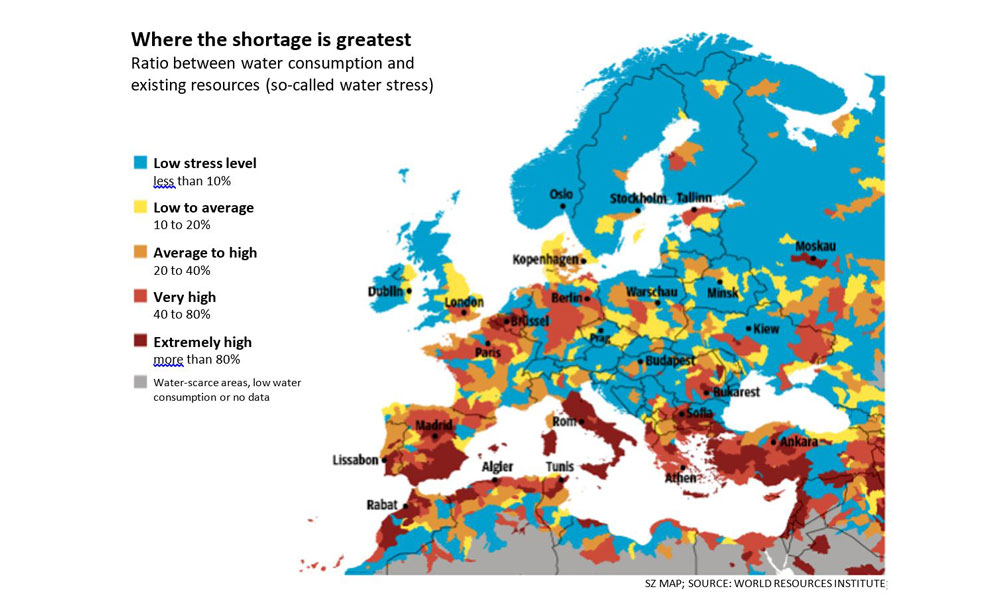
Drought, once seen as a problem only in Mediterranean countries like Spain, Portugal, and Greece, has started affecting Germany, France, the Netherlands, and even Scandinavian nations. The European Union sees this as both a consequence of climate change and a matter of economic and national security. Developments over the past two years show this clearly: * In Germany, water levels in the Rhine River dropped to historic lows. Shipping was disrupted, and steel and chemical production slowed. Germany responded by creating a nationwide digital “Low Water Information System (NIWIS)” to monitor water resources in real time. Restrictions on garden watering and river water extraction were imposed in some regions. * In France, irrigation bans are enforced in many regions during summer, and farmers face water quotas. * The Netherlands has warned it could soon face “actual water scarcity.” * In southern Spain, water levels in some dams have fallen to critical lows, severely damaging agricultural production. Scientists say this is not just a meteorological issue but a structural water management problem. A structural water management problem means that the ways water is controlled, distributed, stored, and used are not equipped to deal with changing availability and growing demand. This includes outdated infrastructure, inefficient allocation of water resources, and lack of long-term planning, which can make water shortages worse even when there is normal or only slightly reduced rainfall.
What measures is the European Union taking?
The European Commission has launched a comprehensive Water Resilience Strategy for the 2025–2026 period. This strategy comprises over 50 actions. Key objectives include:
- Increasing water efficiency by at least 10% by 2030. Measures such as reducing leakage and promoting smart meters and water-saving technologies are being encouraged.
- Reusing treated wastewater. The use of advanced-treated water—rather than drinking water—is being promoted, particularly for agricultural irrigation.
- Storing rainwater. Plans include rainwater harvesting in urban areas, as well as the implementation of permeable pavements, green roofs, and water-retention parks.
- Protecting groundwater reserves. Stricter controls are being introduced regarding excessive groundwater extraction.
- Reducing water pollution. New regulations will ensure stricter monitoring of PFAS, microplastics, pharmaceutical residues, and certain pesticides. PFAS are a group of human-made chemicals used in products like non-stick coatings and firefighting foams, but they can contaminate water and are difficult to remove. Microplastics are small plastic particles less than five millimeters in size that come from sources such as synthetic clothing and the breakdown of larger plastic waste; these can accumulate in water supplies and harm both animals and humans.
- Agricultural transformation. Practices such as drip irrigation, precision agriculture, the use of drought-resistant crop varieties, and methods that enhance soil water-retention capacity are being encouraged.
What might happen over the next decade?
The following practices are expected to become more widespread in Europe:
- Mandatory rainwater storage systems in cities,
- Greywater recovery in new buildings,
- Agricultural irrigation quotas,
- Tiered pricing based on water consumption,
- Drought-resistant landscaping,
- Closed-loop water use in industry,
- AI-powered water management systems.
These developments show that water has become a strategic resource in Europe, like energy. Because of climate change, both floods and prolonged droughts and water scarcity have become key issues on Europe’s environmental and economic agendas. For citizens, this could mean facing stricter water usage rules at home, higher water bills, or restrictions on when they can water gardens and wash cars. Industries such as agriculture and manufacturing may need to adopt new technologies and change production processes to use less water or recycle it more efficiently.
Dursun Yıldız(MSc.) is a hydropolitics specialist and the Director of the Hydropolitics Association, located in Ankara, Türkiye. He is a civil engineer and was formerly Deputy Director at the State Hydraulic Works in Türkiye; he completed a hydroinformatics postgraduate course at the IHE in Delft, a technical training programme at the USBR in the USA, and a master’s degree in Hydropolitics at Hacettepe University, Türkiye.