 Yusuf KANLI
In Amsterdam, olive trees bear fruit in pots far from the Mediterranean, their quiet resilience set against the city’s passing electric cars and the climate summit’s failure to agree on fossil fuels.
YUSUF KANLI
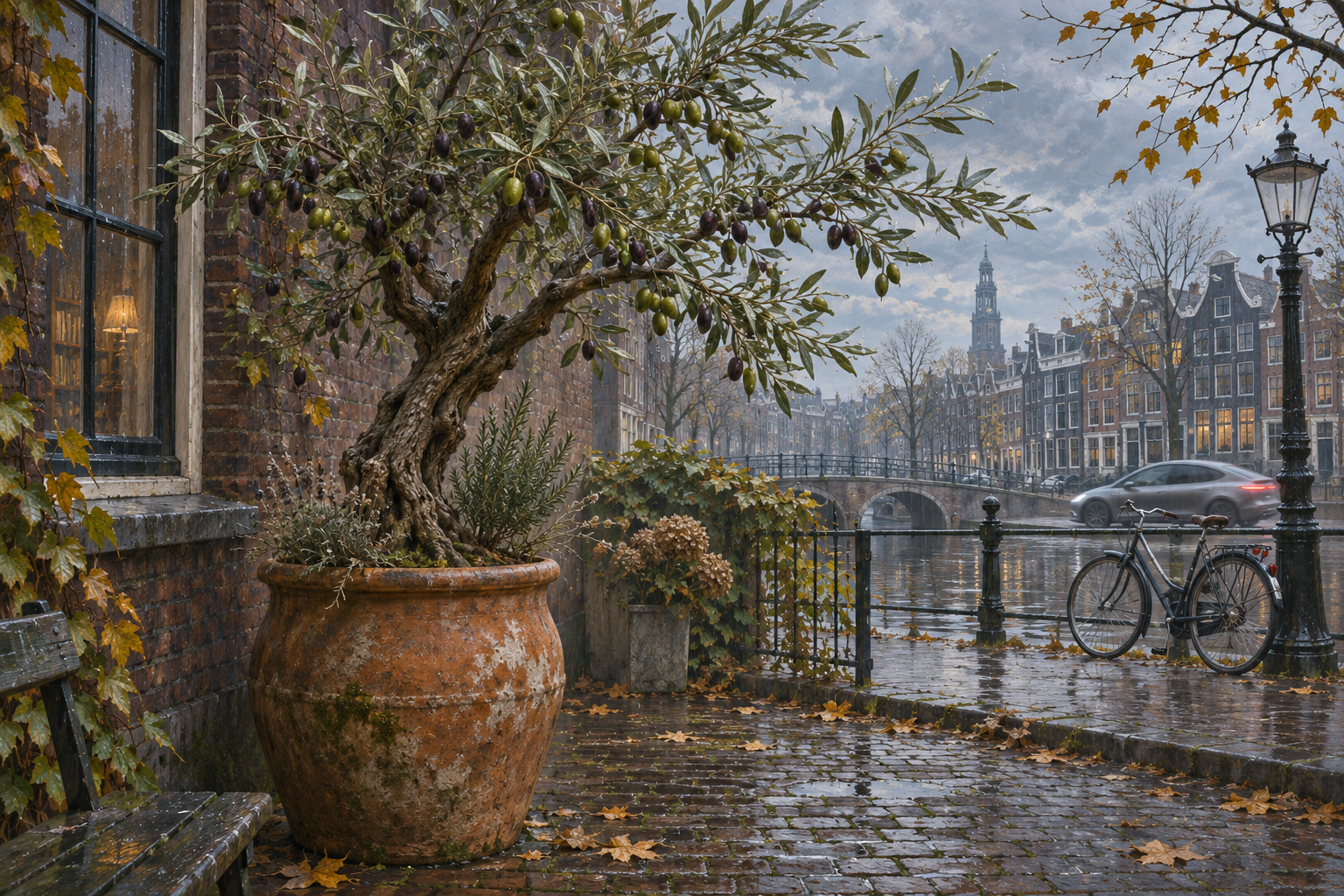
In the neighbour’s garden, right outside the supermarket, on the corner… Every few houses along the road, in the little courtyards by the front doors. In the inner courtyard of a housing complex with dozens of flats, beside the parking area. Defying the smell of exhaust fumes, their branches are laden with small, shy, bead-like olives at a time when the harvest has long since begun in the Mediterranean—while these trees have not so much as flowered.
Shy olive trees in Amsterdam.
Alone. Untended. Yet, despite a climate alien to their nature and soil they cannot call home, they have taken root in large pots, their branches adorned with tiny olives.
Will anyone pick them? And if they do, will it be worth the effort?
A strange, solitary olive tree.
When I first noticed them, autumn was setting in. Amsterdam’s trees were scattering their yellows, reds and browns across the streets. The wind lifted leaves from the canals and carried them somewhere else. The sky was a grey canopy, with the promise of rain for much of the day. People hunched over their bicycles, hurrying into the wind. Trams rattled along the rails as if they, too, had somewhere urgent to be.
The olive trees, though, were in no hurry.
They waited in pots by apartment entrances, against stone walls, their leaves a shade somewhere between brown and green. Who knows where they came from, and in which summer? Did they grow in a nursery, travel on the back of a lorry, or cross from one port to another as a keepsake from someone’s long journey? I don’t know. What I do know is that their branches, accustomed to the Mediterranean sun, were quietly receiving the cold wind from the North Sea.
Their pots were large, to give their roots room. But however wide a pot may be, it is not a garden. A courtyard does not become an olive grove. The tree lives in a portable homeland: one that can be moved to another doorway, brought indoors when winter comes or discarded if its owner’s enthusiasm fades.
And yet it had taken hold.
The Silence Passing By
An electric car passed us. It made almost no sound. For a moment it took some of the city’s usual noise with it, then turned the corner and disappeared. It left no smoke behind. But the silence it left in its wake prompted a question: Are we already too late to do anything about all this?
A shift to clean energy can change the air in our cities, reduce traffic noise and cut the pollutants released by exhausts. But an electric car gliding past in silence does not mean the climate crisis has quietly receded. How the electricity is generated, what resources go into making batteries, how much of our transport depends on cars, how much room our cities leave for people and nature: these questions still await answers.
The car passing the olive tree and the tree itself seem like two sentences in the same story. One reminds us that change is possible; the other, that change has yet to put down deep enough roots.
At the United Nations climate summit, which ended in Antalya a few days ago, the silence took a different form. After two weeks of negotiations and prolonged talks, countries failed to agree on common language for moving away from fossil fuels or reducing their use. The summit closed without a final climate agreement; the decisions under discussion were not adopted. At the heart of the dispute was how the future of coal, oil and gas should be addressed in the text.
As negotiators weighed their words inside the summit halls, the seasons carried on following their own calendars elsewhere. Droughts, floods, heatwaves and wildfires do not wait for decisions around a negotiating table. Nor do the olive groves of Antalya. Nor do the small trees in Amsterdam.
Does a tree care which diplomatic formula is used to describe “the phased withdrawal from fossil fuels”? Perhaps not. But whether that phrase is written into an agreement tells us what the people deciding the tree’s future are willing to accept. The failure to reach consensus was more than a text the delegates could not agree on. It revealed the distance between the limits of nature and the limits politicians are prepared to set for themselves.
The Memory of the Fruit
Perhaps the homeowners bought their olive trees after a holiday: in a southern seaside town, on an island, or at a little roadside nursery. In recent years, it has become fashionable to bring a trace of our beloved Mediterranean to doorsteps and courtyards, even if it needs protection in winter. A little affectation, certainly. But what is wrong with a little dreaming? While we go on destroying our beautiful olive groves, others are carrying the Mediterranean atmosphere into northern European cities. Amsterdam’s garden centres sell potted plants, olive trees and even a few olives. Believe it or not, they have fig trees and palm trees, too. A quiet fragment of a distant place, brought into everyday life…
Then Amsterdam’s winter arrived. Rain seeped between the stones; darkness fell early. The wind tested the branches, and the soil in the pot grew heavy with water. Did the owners bring the trees indoors? Cover them with something? Or leave them outside, saying, “They’ll probably manage”? I don’t know. We cannot infer what happened to one tree from the story of another.
Loneliness is much the same. From the outside, it can seem the same for everyone. But for one person it may be a house with no light in the window; for another, a home full of light where nobody speaks their language. Some kinds of loneliness are loud. Others grow almost imperceptibly in a pot on the corner.
Olive trees do not speak. Perhaps that is why we find so much to say about them.
The olive has never been merely a fruit. It became a symbol of peace; its branch was carried from hand to hand. Its oil lit lamps in darkened homes, flavoured meals and was rubbed into wounds. For thousands of years, olive trees grew in the same soil, bearing witness to people’s wars, migrations, agreements and returns.
When a tree lives long enough, it remains after the person who planted it is gone. A child carves their name into its trunk, then grows up and moves to another city. In time, the tree covers the name. People come and go; the tree counts the seasons. Perhaps this is the source of the olive’s quiet dignity: it knows that time does not belong to us alone.
Do the olive trees in Amsterdam have a history like that? Perhaps not. Perhaps they were planted only a few years ago, to stand at the threshold of a new home or a new life. Still, the olives on their branches give them a memory. They suggest that a tree can carry not only the present, but the memory of another climate.
The Harvest Question
When I look at those olives in autumn, I think of the Mediterranean harvest. Nets spread beneath the trees, branches gently shaken, fruit caught before it falls to the ground… Baskets, sacks, the scent of olive oil. Harvesting is not simply a matter of taking what the tree gives. It is work that brings families, neighbours and villages together. One person holds a branch while another shakes it. Children gather the olives that fall. At the end of the day, hands are dark and backs are tired, but the courtyard is alive.
There is no such crowd around the tree in Amsterdam. Its olives hang untouched, like tiny beads. Who will pick them? The owner? A neighbour? Will someone leaving the supermarket stop to ask, “Can you eat these?” Or will the fruit wait on the branches until it eventually falls?
And if someone does pick them, what then? Can they be cured? Are there enough to make oil? Or will a handful of olives be left in a jar as an experiment? There may be too few to harvest properly, but enough to prove that the tree has borne fruit.
The passing electric car, the deadlock at the climate summit and the fruit in the pot may seem like separate things. But they lead to the same question: What will we do with what nature gives us? Will we see it only as a pleasing view, a showcase for technology or a talking point in diplomatic negotiations? Or will we take care of it, share the cost and accept the responsibility?
The Pot, the Roots and the City
A small olive tree can hold a question in its pot: Is living somewhere enough to belong there? Does belonging begin in the place where you were born—or when someone gives you water, learns your name and protects you from the winter cold?
Trees have no answers to these questions. Their task is to live: to send their roots as deep as they can into the narrow soil allotted to them, to drink the rain, open their leaves when they find light, protect their trunks as the climate changes. To bear fruit despite everything.
But we should be careful with the phrase “despite everything”. Not every tree can withstand the same cold; not every root can live in a pot; not every fruit ripens. Sometimes branches wither. Sometimes a summer upends all the tree’s plans for the future. Resilience does not mean enduring everything that comes your way. Sometimes it means showing that you need help.
Perhaps Amsterdam’s olive trees need care: more suitable soil, more sunlight, somewhere sheltered in winter. Perhaps all they need is someone to look closely at their branches. Planting a tree in a pot does not, by itself, give it a life. We must give it time if we want that life to continue.
Isn’t it the same for people? Moving somewhere, entering a home, holding a key: these may be beginnings, but they do not, on their own, put down roots. Roots grow through encounters and small acts of kindness, around tables where you can make yourself heard. They grow when someone gets your name right, when someone listens patiently to your story. A city must do more than take people in; it must let them live and contribute.
Care for the environment, too, is not a matter of decoration. A potted tree can bring the Mediterranean to mind, but protecting the climate takes more than multiplying beautiful symbols. We must transform transport, clean up energy, reduce consumption and waste, and change our relationship with nature. An electric car passing quietly may be a sign of progress. But a beginning is not a destination. The text countries could not agree on in Antalya was more than a piece of paper. It asked how much we are prepared to commit to our shared future.
Looking Closely at the Branches
One day, I stopped in front of one of those trees. Some of the olives were green; many were small and black. A few seemed almost too shy to grow any larger, hiding among the leaves. One swayed in the wind and brushed against a leaf beside it. Nothing changed. Then the wind died down.
People passed by. One was looking at a phone. A child rang a bicycle bell. A door opened; another closed. The tree was still there. I had not seen anyone water it, but the soil was not completely dry. I did not know who had planted it or how long it had been there. It made no effort to tell its story. Perhaps not because it had nothing to say, but because no one had yet asked to listen.
Will these olives be picked? Will the tree survive the winter? Will the pot be moved to another home, or will it wait for spring in the courtyard where it stands?
I don’t know the answers. I know only that this year, however modestly, the tree bore fruit.
Perhaps someone will pick the olives and look up how to cure them. Perhaps they will turn out too bitter to eat, but someone will try them anyway. Perhaps a bird will take a few. Perhaps the rain will bring them down to the ground.
The tree’s story may not depend on which of these things happens. Sometimes the meaning of something lies not in whether it proves useful, but in the way it continues to live: its roots embracing soil that does not belong to it, its branches reaching into an unfamiliar sky, its fruit appearing in a season it never expected.
In Amsterdam, olive trees grow in small pots in apartment courtyards and outside supermarkets. We think of them as lonely. Perhaps they are. But the olives hidden among their leaves tell us something: a tree is an olive tree not only because it remembers where it came from, but because it can still grow where it is.
Still, we should not leave its fruit on the branch.
Will anyone pick the olives? And if they do, will it be worth the effort?
Perhaps the first question comes before the second. Care for a tree does not always begin by calculating what we can get from it. Sometimes we simply notice: the one trying to put down roots, preparing for winter, quietly carrying its fruit. Then we bend closer and look carefully at its branches.
And one day, who knows, we may take one of those little olives in the palm of our hand. Without asking which country it belongs to. Knowing only that it has grown.