Author: Dr. Huzur Keskin
Data Cut-off Date: November 2, 2026
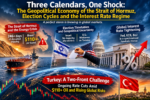
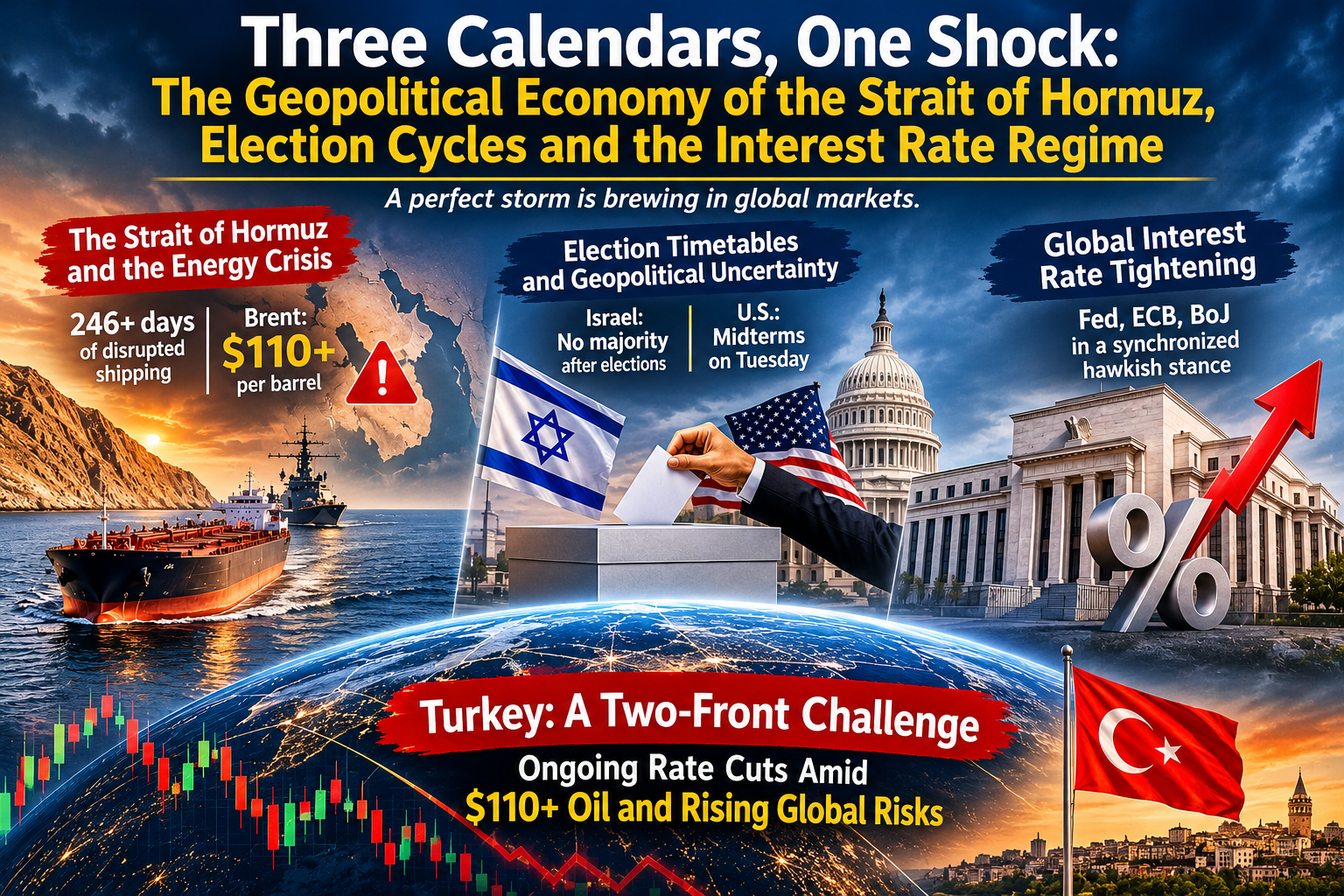
Global markets this week are facing three separate calendars at once: the military-diplomatic calendar of the war and the Strait of Hormuz, the election calendar of Israel and the United States, and the tightening calendar of central banks. These three calendars are intertwined to such a degree for the first time. The energy shock is no longer temporary; commercial transits through Hormuz have been effectively at a standstill for a period exceeding 246 days, and Brent has been carried from around 67 dollars before the war to above 110 dollars. This is not a “price spike” but a permanent cost layer that is rebuilding supply chains and the interest rate regime. Central banks are responding to this shock with tightening: the Fed raised rates in September, held in October with two dissents, and a December hike is being priced in; the ECB raised twice this year; the BoJ is in a hawkish wait. This is the first risk of simultaneous global tightening since 2022. The artificial intelligence rally is also undergoing an interest rate and cash flow test; in October the Nasdaq fell about 10 percent from its peak. The issue is not weakness in AI demand; it is free cash flow turning negative while financing costs rise. Political uncertainty, meanwhile, has created an “action window”: in Israel the election gave no one a majority, and in the US the midterms are being held on Tuesday. According to reports in the press, the US decision on a new attack against Iran has been postponed until after the elections; the post-election period stands out as the highest-variance period for both escalation and negotiation. For Türkiye, the equation is double-edged: the Central Bank continues cutting rates while oil is above 110 dollars, and this tests the disinflation program at its most fragile point through the energy import, current account balance, and reserve channels.
- Framework: Why “Three Calendars”?
Markets usually price geopolitical risk, monetary policy, and corporate earnings as separate headings. Today, however, these headings have become links in a single chain. Because Hormuz is closed, oil and refined product prices remain high, which in turn distorts inflation expectations. When inflation deteriorates, central banks raise rates and long-term bond yields rise; the US 10-year yield is around 5 percent. A high discount rate hits long-duration growth stocks, that is, the artificial intelligence investment story. Election results, meanwhile, determine the political speed limit of this chain: the will to continue the war, budget and tax policy, appointments. For this reason, interpreting the individual headings is insufficient; the real question is which link in the chain will break first.
- Oil and Hormuz: A Temporary Shock or a New Regime?
According to tracking platform data, the daily number of transits through Hormuz has fallen to single digits, even as low as 2, at the end of October, compared with around 85 before the crisis; more than a hundred ships are waiting without docking at port. The Iranian navy claimed in the first days of November that two tankers had struck mines; however, there is no confirmation from an independent maritime authority. Brent was trading in the 111-113 dollar band on November 1; in October it rose about 15 percent and climbed to as high as 116-117 dollars by month-end. Europe announced the release of 42 million barrels of strategic stock over three months; this stock consists predominantly of diesel.
The diplomatic front remains deadlocked. The Islamabad memorandum of June collapsed in July, and clashes resumed accompanied by a US naval blockade and air operations. Iran is putting forward seven conditions for opening Hormuz: the lifting of the blockade, an exemption on oil sanctions, the release of frozen funds, recognition of the Iran-Oman route, a reduction of the US military presence in the region, and a ceasefire on all fronts including Lebanon. The US, for its part, makes nuclear concessions a precondition for negotiations. President Trump rejected the seven-day proposal in September.
Three points must be underlined here. First, the Lebanon link: because one of Iran’s conditions is a ceasefire in Lebanon, the Lebanon policy of the government to be formed in Israel becomes directly a variable of Hormuz diplomacy; Israeli domestic politics is now an input of the oil price. Second, the divergence between price and physical supply: it was noted in August that oil exiting the strait had recovered to 7-9 million barrels per day and that, in various estimates, the bulk of Gulf exports had been recovered through different routes. However, the October attack wave and the mine claims show that even if crude oil volumes recover, product prices will remain high due to insurance, freight, and refinery bottlenecks; the record profits that refinery margins bring to the major oil companies are a sign of this. Third, market pricing: current Brent is pricing the “prolonged but managed crisis” scenario rather than the full closure scenario. This means that the upside tail risk, that is, the 120-125 dollar band in the event of escalation, is wider than the downside tail.
- The Political Calendar: Post-Election Uncertainty in Israel, on the Eve of the US Midterms
3.1 Israel: A Deadlocked Knesset
According to the results of the October 27 elections, Netanyahu’s right bloc won 53 seats; in the previous parliament it had held a peak of 68 seats. The opposition Jewish parties led by Gadi Eisenkot took 48, while the Arab parties took a historic record of 19 seats. No bloc reached the 61 required for a majority; both Netanyahu and Eisenkot had ruled out forming a government with the Arab parties before the election. The election committee announced that it found no basis for Likud’s “the election was stolen” claims. Following the approval of the results, President Herzog is expected to assign the mandate to form a government to one candidate; difficult negotiations that could last for weeks are anticipated.
Two scenarios stand out from a market and geopolitical perspective. In the incumbent government scenario, Netanyahu remains in office during the prolonged coalition negotiations and retains his war powers. According to reports in the press, Netanyahu had planned a broad operation against Iran in October, but Washington had it postponed until after the midterms; the Israeli Prime Minister’s Office denied some claims, while the White House denied the report that the two leaders had discussed an attack before the election. A weakened leader’s search for a “show of strength” should be read as a channel that raises the risk of escalation. In the alternative government scenario, even if the opposition can form a government, it may need the external support of the Arab parties; this means both fragility in domestic politics and a relatively more measured line in Lebanon-Gaza. However, it should not be forgotten that the opposition leaders are also hawkish on Iran; this scenario does not automatically loosen the Hormuz equation. In either case, uncertainty will last long, and this will lead to the regional risk premium becoming permanent.
3.2 The US: A “Blue Wave” Is Priced In
In the midterm elections to be held on Tuesday (November 3), Republicans hold a 53-47 majority in the Senate, while they retain a narrow majority in the House of Representatives. Forecast models and prediction markets give Democrats a roughly 84-94 percent chance of winning the House and 64-78 percent in the Senate; some assessments classify the Senate as a “coin toss.” In national generic ballot polls Democrats are clearly ahead, while the President’s approval rating is in the high 30s.
In terms of economic implications, divided government means deadlock on the budget and authorities. A Democratic House will create leverage for oversight and votes on war powers, tariffs, and spending cuts. From a market perspective, this may increase policy predictability but reduces the probability of new fiscal stimulus. The Senate is critical: appointments including Fed board membership, war powers votes, and the legislative agenda depend on the Senate balance. The test of the Fed’s insulation from politics also coincides with this period. Chair Kevin Warsh said the election issue was never discussed at the meeting; the market will nonetheless read this politically. After the election, resolve in the direction of rate hikes may be the first real test of Fed independence.
3.3 The Intersection of the Two Elections: The Action Window
According to reports, Trump stated clearly in October that he would not launch a new attack before the elections; it was reported that the Israeli military and CENTCOM were continuing their preparations. This turns the weeks after November 3 into a historically unusual “decision window”: the election constraint in the US is lifted, the coalition formation process begins in Israel, and the Fed prepares to meet in December. In this window, two-way outcomes are possible: military escalation or a widening of the post-election negotiating space.
- Central Banks: The Tightening Response to the Energy Shock
Last week’s decision sequence showed that central banks are in a different dilemma than in 2022: inflation is rising from energy sources while growth weakens. The Fed kept the policy rate unchanged in the 3.75-4.00 percent range on October 28; the decision was taken by a 10-2 vote. A 25 basis point hike had been made in September; Lisa Cook and Beth Hammack wanted a hike, and the probability of a December hike is priced above 80 percent in the market. The ECB kept the deposit rate unchanged at 2.50 percent on October 29; two hikes had been made this year. A hike was discussed in the Council but was deferred due to the jump in French bond yields, and President Lagarde’s early departure was announced. The BoJ kept the policy rate unchanged at 1.25 percent on October 30; the decision was taken by an 8-1 vote, with Takata wanting 1.5 percent. It was emphasized that inflation is consistent with the 2 percent target, and a decision was taken to accelerate ETF sales. The TCMB, meanwhile, cut the policy rate by 100 basis points to 36 percent on October 22; it drew attention to the upward energy risk stemming from geopolitics and left the tightening option open in the event of a permanent deterioration.
Here it should be recalled that the September hike on the Fed side was the first since 2023. The fact that the US 10-year Treasury yield was above 5 percent and the 30-year around 5.3 percent in October shows that long-term financing conditions are already tight. September employment growth is reported to have been only about 29 thousand; if true, the Fed is hiking on the brink of stagflation. On the ECB side, institutional uncertainty poses an additional risk; while Lagarde’s leadership process is interrupted, bond tension in France continues, and a delay in determining her successor will create volatility for the Euro Area in terms of interest rate spreads. On the BoJ and yen front, the dollar/yen is around 157-158; Japan’s Finance Minister gave an intervention signal. If the widening interest rate differential between the US and Japan does not narrow, the unwinding of yen carry trades could become a second source of shock for global risk appetite. The common denominator is this: no major central bank has the luxury of “ignoring” the energy shock, because expectations have already been facing high inflation for years.
- Technology Stocks: The Interest Rate and Cash Flow Test of the AI Rally
In October the Nasdaq had its worst month in over a year and closed about 10 percent below its peak. On October 30, the S&P 500 suffered its sharpest daily loss since June (about 1.8 percent), while the Nasdaq fell 2.9 percent. In mid-October, more than 1 trillion dollars of value was erased in AI and chip stocks in a single week. The message of the earnings season is clear: the market now says “cash generators win,” not “spenders win.” Microsoft’s revenue was 92.3 billion dollars, Azure growth was 48 percent, and free cash flow was positive; the stock rose. Alphabet’s quarterly investment spending was about 51 billion dollars, free cash flow has been negative for two quarters (about -9 billion dollars), 2026 investment guidance is 195-205 billion dollars and is expected to increase further in 2027. Although cloud revenues doubled, the stock fell about 13 percent, losing about 500 billion dollars in value; a slowdown in core search advertising also raised concerns. Amazon’s cash flow and results were disappointing; Intel lost about 29 percent of its value in a single day on weak guidance. The 2026 AI investment of the major technology companies is in the 720-830 billion dollar range in various compilations.
The main thesis is built on the interest rate link. Part of the investment spending is financed with debt and new equity issuance; it was reported that corporate default insurance premiums have risen. With the US 10-year yield around 5 percent, the “value” calculation of an investment program with negative cash flow becomes structurally difficult. For this reason, a direct negative relationship has formed between the expectation of rate hikes and AI valuations. Among the upcoming tests are Apple’s balance sheet and Nvidia’s results in mid-November; these will show whether end demand and chip supply can carry this pace of investment. Nvidia’s third-quarter revenue guidance disclosed by the company is about 108 billion dollars; this figure shows that there is not yet a crack on the supplier side of the AI cycle. The real break is on the customer side, that is, in the financing capacity of the hyperscalers. In terms of the political link, a Democratic House may increase regulatory pressure on competition and AI regulation targeting the technology giants; although this is not a short-term valuation catalyst, it may become one of the permanent components of the risk premium.
- A Unified Reading: Three Scenarios
What is stated here is a subjective assessment; it is not a model output and should not be read as a price forecast. The base scenario stands out with a weight of about 50 percent as the “prolonged crisis”: there is partial transit and continuous attack risk in Hormuz, Brent trades in the 100-125 dollar band, the Fed hikes in December, and the US long-term yield stays around 5 percent. In this scenario, a rotation toward companies with positive cash flow in technology and risky assets and a gradual downward adjustment in the sector are expected. The second scenario, with a weight of about 30 percent, is “post-election escalation”: a new air operation, Brent jumping above 125 dollars, an energy-driven inflation shock, demand for safe havens, and a stronger dollar. In this case, a deep correction and current account stress in emerging markets come to the fore. The third scenario, with a weight of about 20 percent, is “negotiated opening”: with a phased transition and limited volume, Brent falls back to 85-95 dollars, rate hike expectations ease, and a relief rally is seen; however, the investment spending question remains on the table.
The “threshold” indicators that could break the chain are these: Brent permanently exceeding 125 dollars; the US 30-year approaching around 5.5 percent; a hyperscaler cutting its investment targets on cash flow grounds; a sudden sharp move in the dollar/yen; a sudden widening in default insurance premiums.
- Implications for Türkiye
As a net energy importer and an economy sensitive to external financing, Türkiye is exposed to both the energy and interest rate links of this chain at the same time. On the monetary policy front, the TCMB cut the policy rate from 37 percent to 36 percent in October; in the Market Participants Survey, the end-2026 inflation expectation rose to 29.6 percent and the end-2027 expectation to 23.3 percent. The MPC summary explicitly included the upward risk stemming from energy and commodities and the tightening option in the event of a permanent deterioration. The next steps are October inflation on November 3, the Inflation Report on November 12, and the MPC meeting on December 10. While the Fed and ECB are hiking, the TCMB continuing to cut erodes the interest rate differential advantage.
On the current account balance side, a domestic analysis, citing TCMB accounts, states that every 10 dollar increase in the oil price raises the current account deficit by 2.6 to 5 billion dollars and inflation by 1.2-1.6 points; there is a difference in range among sources, and it should be confirmed with the TCMB’s current sensitivity estimate before publication. The fact that Brent is trading well above the 2026 budget assumption puts pressure on the budget through energy subsidies and the excise duty/bracket mobile mechanisms. On the reserve and exchange rate front, some institutional reports contained a warning of a decline of about 11 billion dollars in reserves before October; for this reason, the cut steps must be read together with reserve and CDS indicators. Strategically, alternative energy corridors to Hormuz and transit routes through Türkiye could be a bargaining chip; however, presenting this as a “gain” without evaluating the existing infrastructure capacity and political risks would be premature. On the political side, the Lebanon and Gaza policies of the coalition process in Israel are an indirect but noteworthy variable for Türkiye’s regional diplomacy and Eastern Mediterranean calculations.
- Policy Recommendations and Monitoring List
Four headings stand out for policymakers. First, make monetary policy communication conditional on the energy price: an automatic slowdown in the pace of steps if Brent exceeds a certain threshold preserves the reserve and expectation anchors. Second, design targeted (not general) energy support: while general subsidies weaken the rate cut through the budget and current account channel, targeted support for vulnerable groups is more resilient. Third, accelerate strategic stock and supply diversification; Europe’s stock release sets a precedent, and scale and duration alignment are critical. Fourth, from a financial stability perspective, monitor the ECB succession and the yen carry risk; both directly affect capital flows to emerging markets and borrowing costs.
In terms of the monitoring calendar, the US midterm elections and Türkiye’s October inflation on November 3, the approval of the results in Israel and the assignment of the mandate to form a government between the first week of November and November 10, the TCMB Inflation Report on November 12, Nvidia’s balance sheet in mid-November, the FOMC on December 8-9, the TCMB MPC on December 10, and the ECB meeting in December should be followed. These events are important, respectively, for the Congress balance and TCMB communication, the coalition and Lebanon line, the intermediate target and oil assumptions, the health of the AI supply chain, the December hike and new projections, the year-end interest rate path and the hike decision, and the succession.
Methodological Note and Limitations
This study is based on publicly available news and data sources as of November 2, 2026. Because figures change rapidly in a war and election environment, Brent, yields, Hormuz transit counts, and the official approval of Israeli results may need to be updated after publication. Hormuz transit data and some market commentary come from semi-automated compilation or secondary sources; they are used for order of magnitude and it is recommended that they be linked to primary sources (IMF PortWatch, the relevant central bank and exchange data) in publication. The October employment figure and some stock movements were taken from a single compilation source. Midterm election probabilities are model and prediction market averages; they are probabilities, not forecasts. Scenario weights are subjective judgment. This study absolutely does not constitute investment advice.
Main Sources
For Israeli election results, ABC News, Al Jazeera, NBC News and AP/PBS (October 29 – November 1, 2026);
For the Fed October decision, CNBC, Fox Business, Advisor Perspectives and InvestingLive (October 28, 2026);
For the ECB and BoJ, FXStreet, Dukascopy, Bloomberg (October 13) and Admiral Markets (October 2026);
For the TCMB, the TCMB MPC announcement and summary, Ekonomim, Investing.com Türkiye and the İş Yatırım assessment (October 2026);
For Hormuz and oil, Al Jazeera, straits.live, FX Leaders, Oilprice, the Wikipedia oil chronology, CBS News, Iran International and Kayhan;
For Israel-US-Iran coordination, Axios, Financial Times (as cited by Times of Israel), CNN and Semafor; for the midterms, Decision Desk HQ, Fox News, CNBC, Kalshi, Polymarket and Forbes (November 2026);
For technology balance sheets, use was made of sources from Paralia Weekly Brief, TheStreet, Stocktwits/Yahoo Finance, Nasdaq Playbook and Tech Insider.