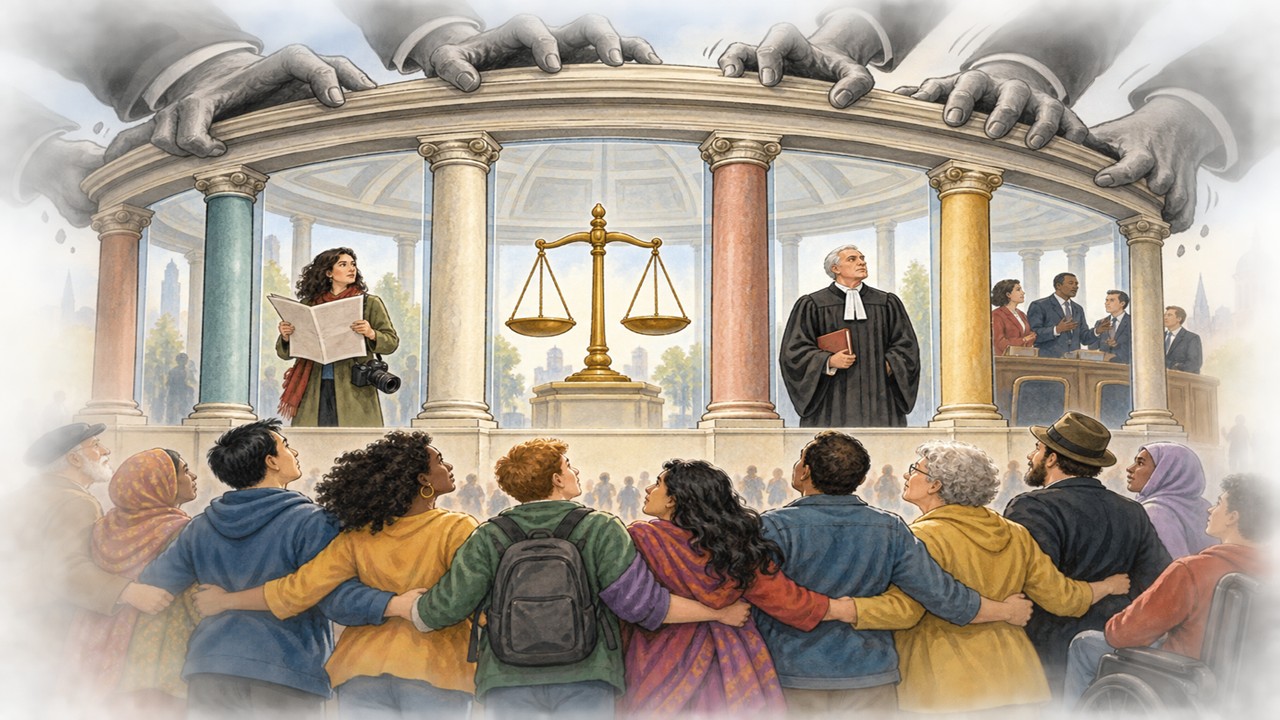
Democracy has many colours, but it has a common grammar
Democracy may reflect different histories, cultures and social priorities, but it cannot be reduced to elections or reshaped until its essential safeguards disappear. Whatever its local colour, democracy requires the supremacy of law, freedom of thought and the press, transparency, accountability, separation of powers and institutions capable of restraining those who govern.
By Yusuf Kanlı
Democracy has never looked exactly the same everywhere. It may be parliamentary or presidential, federal or unitary, secular or influenced by religious traditions. It may favour extensive social welfare, strong local government, direct participation or a predominantly representative model. Every society inevitably adds something of its history, political culture and collective character to the institutions through which it governs itself.
This variety is not democracy’s weakness. On the contrary, democracy survives because it can accommodate differences, correct its mistakes and answer changing social needs without resorting to violence or revolution. Yet adaptability must not be confused with limitlessness. Democracy can wear many colours, but it cannot mean whatever those in power decide it means.
Beneath its many forms lies a common grammar: the supremacy of law, freedom of thought and expression, press freedom, transparency, accountability, separation of powers, independent institutions, political pluralism and genuinely competitive elections. Remove these elements one by one and democracy does not simply become a different model. It gradually ceases to be democracy.
More than the ballot box
The most persistent misconception is that democracy begins and ends with elections. Elections are indispensable, but they are not sufficient. Authoritarian governments can hold regular elections, maintain parliaments and permit several political parties to operate. They may even tolerate limited criticism, provided that it never threatens the governing order.
But when the government controls the courts, silences critical media, deploys public resources for partisan purposes, prosecutes political opponents or alters the rules whenever electoral defeat becomes possible, the ballot box becomes democratic decoration for concentrated power. Elections remain on the calendar, but the conditions that give them meaning have disappeared.
An election becomes democratic only when citizens can make informed choices, candidates can campaign without intimidation and political parties can compete under reasonably equal conditions. Votes must be counted honestly, institutions must respect the outcome and those in power must accept the possibility of losing.
Democracy therefore begins long before a vote is cast and continues after the votes are counted. Its decisive test is not whether a government was once elected, but whether the system preserves the genuine possibility that another government may be elected tomorrow.
The supremacy of law
The first indispensable principle is the supremacy of law. This means more than having constitutions, statutes, courts and prosecutors. Every authoritarian system has laws and institutions bearing familiar names. The essential distinction is between the rule of law and rule through law.
Under the rule of law, those who govern are subject to the same legal order as those who are governed. Public power is limited, official decisions can be challenged and citizens can reasonably predict how the state will act. Laws must be public, intelligible and applied without political discrimination. Courts must be able to review executive conduct, protect fundamental rights and deliver judgments that the government cannot simply disregard.
Under rule through law, legislation becomes an instrument of political command. Laws are written broadly, applied selectively and repeatedly amended to justify decisions already taken. Opposition figures are investigated while comparable allegations involving government supporters remain untouched. Critical speech becomes a security offence, administrative regulations are used to weaken civil society and judicial proceedings themselves become a form of punishment.
A democratic government does not prove its respect for law by frequently invoking legislation. It proves it by accepting legal restraints when they are inconvenient. The rule of law matters most when courts rule against the government, when prosecutors investigate powerful people and when public authorities are compelled to explain or reverse their decisions.
Freedom of thought and expression
Democracy requires more than permission to praise the government or discuss harmless subjects. Freedom of thought and expression matter precisely because they protect dissenting, unpopular and uncomfortable ideas.
A society in which citizens speak only after calculating the probable reaction of the police, prosecutors, employers or organised political groups may preserve the outward appearance of public debate. Yet beneath that appearance, fear is setting the boundaries of permissible thought.
Freedom of expression is not an indulgence granted by a tolerant ruler. It is the mechanism through which societies identify mistakes, expose injustice and develop alternatives. Governments possess superior resources, greater visibility and extensive means of constructing an official narrative. Unless citizens, academics, artists, professional organisations and civil society groups can question that narrative, political authority gradually acquires influence not only over government but also over the limits of imaginable thought.
That freedom must apply to political adversaries as well. A person cannot demand unrestricted speech for his own side while welcoming censorship against opponents. Democratic rights acquire meaning through universality. The true measure of freedom is not how a society treats ideas it admires but how it responds to views that disturb, offend or challenge the majority, provided they do not directly incite violence or deprive others of their rights.
No democracy without a free press
Press freedom is the organised expression of society’s right to know. Journalists investigate what governments, corporations and other centres of power may prefer to conceal. They test official statements against evidence, expose conflicts of interest and bring abuses of authority into public view.
Without independent journalism, citizens are asked to make democratic choices under conditions of manufactured ignorance. They may be free to vote, but the information needed to exercise that freedom has been restricted, distorted or withheld.
The press does not have to be flawless to perform its democratic function. It can be partisan, commercially driven, sensationalist and sometimes simply wrong. The proper response to poor journalism is professional accountability, correction, pluralism and better journalism—not political control.
Modern censorship also rarely announces itself as censorship. Ownership concentration, politically distributed public advertising, punitive fines, selective tax inspections, licence pressures, denial of accreditation and strategic prosecutions can silence journalism as effectively as closing a newspaper. The publication may technically survive while its capacity to investigate power steadily disappears.
A government confident in its democratic legitimacy does not need obedient journalism. It needs a press free enough to discover what the government itself may not know, willing enough to expose wrongdoing and diverse enough to prevent any single political or commercial interest from monopolising public truth.
Transparency must lead to accountability
Political authority is exercised on behalf of the public and must therefore be visible to the public. Citizens should be able to learn how decisions were made, how public money was spent, who benefited from government contracts and whether officials used their positions to enrich themselves, their families or their political allies.
Transparency, however, cannot be reduced to publishing mountains of unusable information. Genuine transparency requires timely access to documents, understandable public records, independent auditing, protection for whistle-blowers and a press capable of examining what has been disclosed. It means revealing not only the final decision but also the interests, consultations and calculations behind it.
Accountability takes the principle one stage further. Officials must not merely explain their actions; misconduct must have consequences. Ministers should answer to parliament, administrative decisions should face judicial review and financial irregularities should be examined by bodies independent of those under investigation.
A system in which every scandal produces an official statement but no resignation, impartial inquiry, judicial consequence or institutional correction offers only theatrical transparency. The public is permitted to witness wrongdoing but denied the means to stop it.
Separation of powers is not obstruction
Democracy rests upon a deliberately inconvenient proposition: no individual or institution should possess unchecked power. The legislature makes and scrutinises laws, the executive implements them and an independent judiciary interprets them. These branches must cooperate, but they must also be capable of restraining one another.
Strong leaders often portray such restraints as unnecessary obstruction. Courts are accused of opposing the national will, parliaments of delaying urgent action, auditors of impeding development and journalists of weakening national unity. Yet these institutions exist precisely to slow power down, demand evidence and compel reconsideration.
Their apparent inconvenience is one of democracy’s principal protections. Efficient government may be desirable, but unrestricted efficiency can become merely the ability of rulers to impose their will without consultation, scrutiny or appeal.
Institutions must also be more than buildings, titles and constitutional clauses. A court staffed according to political loyalty may retain its robes and ceremonies while losing its independence. A parliament dominated by executive decrees and rigid party control may continue meeting without exercising meaningful oversight. A regulatory agency led by government loyalists may possess formal autonomy yet lack the will to use it.
The strength of democratic institutions is revealed when they confront power, not when they endorse it. Their purpose is to ensure that the state continues to operate according to rules even when doing so frustrates the government of the day.
Majority rule has limits
Democracy requires majority rule, but it cannot be reduced to it. An electoral majority authorises a government to govern. It does not transfer ownership of the state, the courts, the media or the national identity to the winning party.
Nor does a majority possess the right to extinguish minority rights. If democracy meant only that the larger number could do whatever it wished, elections could legitimise discrimination, persecution and permanent exclusion. Constitutional rights exist precisely because some values must be protected from temporary political majorities.
Majorities also change. Those who applaud arbitrary power when it is used against their opponents may eventually discover that the same machinery can be turned against them. Independent courts, free media and constitutional restraints therefore protect today’s victors as well as today’s defeated.
Limits on government do not contradict popular sovereignty. They prevent sovereignty from becoming the permanent possession of one leader, party, class, ethnic group or ideological camp.
Democracy’s gradual erosion
Democracies rarely disappear in a single dramatic moment. Tanks do not necessarily surround parliament, elections are not always cancelled and constitutions are not formally abolished. Contemporary democratic erosion is usually incremental.
A prosecutor is replaced. A broadcaster is fined. A court’s authority is narrowed. An opposition mayor is removed. A journalist is prosecuted. A public contract is awarded without scrutiny. A civil society organisation is labelled a security threat. An emergency power introduced as temporary becomes permanent.
Each measure is presented as exceptional, technical or necessary for national security. Taken separately, none may appear sufficient to destroy a democracy. Together, however, they alter the character of the state. Institutions remain standing, but their functions are emptied out. Elections continue, but genuine competition diminishes. Courts issue judgments, but justice becomes selective. Newspapers appear, but increasingly repeat the same approved narrative.
Democracy often dies through accumulation. By the time society recognises that the exceptions have become the system, the institutions capable of reversing the process may already have been weakened.
A common democratic minimum
There is no need to impose one political culture or institutional blueprint upon the world. Societies should be free to construct systems suited to their histories, needs and preferences. They may legitimately disagree over the size of the state, the relationship between president and parliament, economic policy, secularism, decentralisation and the mechanisms of citizen participation.
Cultural diversity, however, cannot justify arbitrary government. National sovereignty cannot excuse the persecution of thought. Electoral victory cannot legitimise the capture of courts, and security cannot become an all-purpose licence for secrecy and repression.
The rule of law, freedom of thought and expression, press freedom, transparency, accountability, separation of powers and independent institutions are not decorative additions to democracy. They are the conditions that prevent citizens from being reduced to subjects.
Democracy may speak in different languages, emerge from different histories and assume different constitutional forms. It may indeed have many colours. But unless it subjects power to law, preserves the freedom to dissent, makes government answerable and protects institutions capable of saying “no,” those colours will eventually fade into the single, familiar colour of arbitrary power.